ACADEMY
WHAT IS ROLL FORMING? A PRACTICAL INTRODUCTIONROLL FORMING VS PRESS BRAKE: WHICH ONE, WHEN?HOW TO CHOOSE A SERVO FEEDER STRAIGHTENERHOW TO CHOOSE A DECOILER (UNCOILER): WHAT TO CHECKHOW TO CHOOSE A STRAIGHTENER OR PRECISION LEVELERHOW TO CHOOSE A CUT-TO-LENGTH LINEHOW TO CHOOSE A SLITTING LINEBUYING A ROLL FORMING MACHINE: WHAT TO CHECKCOIL, STRIP AND PRESS TONNAGE CALCULATOR
What Is Roll Forming? A Practical Introduction
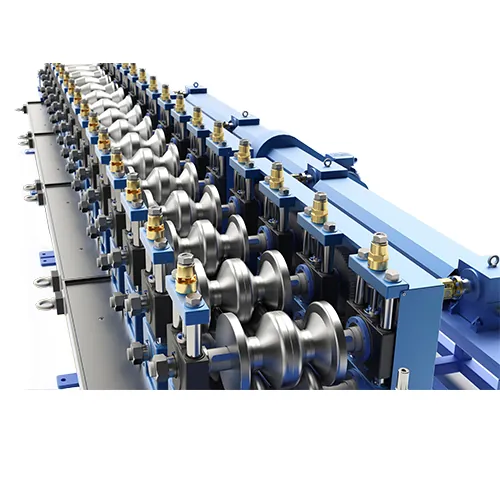
How roll forming works, what a complete roll forming line includes, which materials and profiles it suits, and when it pays off compared with other methods.
Roll forming is a continuous bending process. A long strip of sheet metal, unwound from a coil, passes through a series of roller stands. Each stand bends the strip a little further, until the strip leaves the last stand with the final cross-section — a C or Z purlin, a guard rail beam, a shelf upright or a gutter.
Because every bend is made gradually, roll forming produces long profiles with consistent dimensions at high speed and with very little scrap.
What a complete roll forming line includes
A roll former rarely works alone. A typical line consists of:
- Decoiler (uncoiler) and coil car – holds the coil and pays off the strip.
- Straightener or servo feeder straightener – removes coil set so the strip enters flat.
- Pre-punching – hydraulic or mechanical presses with dies punch holes and slots before forming.
- Roll former – the forming stands with the roller tooling designed for the profile.
- Cut-off – cuts the profile to length, either stop-and-cut or on the fly.
- Run-out table and stacking – collects and stacks the finished profiles.
Which materials can be roll formed?
Galvanized steel, cold rolled and hot rolled steel, pre-painted steel, stainless steel and aluminium are all commonly roll formed. The material grade, thickness and strength determine the number of forming stands, the roller design and the drive power of the line.
When does roll forming pay off?
Roll forming is the right choice when you need the same profile in large quantities or in long lengths. The investment in roller tooling is higher than for a press brake, but the cost per metre is low and the output is continuous.
Quick-change roller cassettes make it possible to produce several profiles on a single line — for example, the guard rail line R&F Machinery installed in Poland produces Ray-A, Ray-B and C post profiles by changing cassettes.
What to prepare for a quote
- Profile drawing with dimensions and tolerances
- Material type, thickness range and strength
- Punching pattern and cut lengths
- Required output (metres per minute or pieces per shift)
- Coil weight, width and inner/outer diameter
Frequently asked questions
What is the difference between a roll former and a roll forming line?
The roll former is the machine with the forming stands. A roll forming line also includes the decoiler, straightener, punching, cut-off and stacking equipment around it.
Can one roll forming line produce different profiles?
Yes. With quick-change roller cassettes and adjustable tooling, one line can produce several profiles or profile widths.
Related machines
Request a quote
Send us your profile or part drawing, material and required output, and our sales engineers will propose the right solution.
GET QUOTE sales@rollandform.com