ACADEMY
WHAT IS ROLL FORMING? A PRACTICAL INTRODUCTIONROLL FORMING VS PRESS BRAKE: WHICH ONE, WHEN?HOW TO CHOOSE A SERVO FEEDER STRAIGHTENERHOW TO CHOOSE A DECOILER (UNCOILER): WHAT TO CHECKHOW TO CHOOSE A STRAIGHTENER OR PRECISION LEVELERHOW TO CHOOSE A CUT-TO-LENGTH LINEHOW TO CHOOSE A SLITTING LINEBUYING A ROLL FORMING MACHINE: WHAT TO CHECKCOIL, STRIP AND PRESS TONNAGE CALCULATOR
How to Choose a Cut-to-Length Line
Stop-and-go or continuous? Leveler, measuring, shear and stacking: the data you need and the questions to ask before investing in a cut-to-length line.
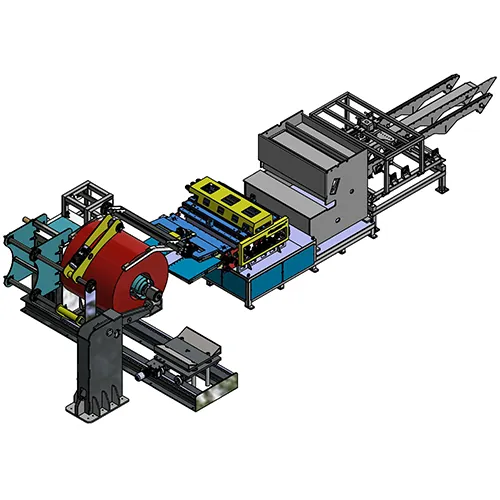
A cut-to-length line unwinds a coil, flattens the strip, measures it and cuts it into flat sheets or blanks, then stacks them. The right configuration depends on your thickness range, sheet lengths, accuracy and the tonnage you need per shift.
What a cut-to-length line includes
- Coil car and decoiler
- Straightener or precision leveler – depending on the flatness you need
- Feeding and measuring – servo feed rolls or an encoder measuring roll
- Shear – usually a hydraulic or mechanical guillotine shear
- Conveyor and stacker – with sheet length and stack height adjustment
- Control system with order lists (length × quantity)
Stop-and-go or continuous?
In a stop-and-go line the strip stops for every cut. It is simple, accurate and economical, and suits most thicknesses and medium outputs.
In a continuous line the leveler runs without stopping and a loop absorbs the difference while the shear cuts – or a flying shear cuts the moving strip. Continuous lines reach higher outputs but need more space and a larger investment.
Data to prepare
- Material grades, thickness, width and strength range
- Coil weight, ID and OD
- Sheet length range and length tolerance; squareness (diagonal) tolerance
- Flatness requirement – this decides straightener or leveler
- Required output in tonnes or sheets per shift
- Surface: protective film, pre-painted or stainless sheets need scratch-free stacking
Shear and stacking
Blade clearance must follow the thickness; automatic clearance adjustment saves time when thickness changes often. For stacking, gravity drop stackers are simple; sensitive surfaces need conveyors that lower the sheets gently, and long sheets need side and end stops for square stacks.
Frequently asked questions
How accurate is a cut-to-length line?
Accuracy depends on the measuring system, the strip flatness and the shear. Specify the tolerance you need for your sheets and ask how it is measured at acceptance.
Can a cut-to-length line also slit?
Some lines combine slitting heads with the shear to produce narrow blanks in one pass. This is useful for multiple narrow blanks from one coil.
Related machines
Request a quote
Send us your profile or part drawing, material and required output, and our sales engineers will propose the right solution.
GET QUOTE sales@rollandform.com