ACADEMY
WHAT IS ROLL FORMING? A PRACTICAL INTRODUCTIONROLL FORMING VS PRESS BRAKE: WHICH ONE, WHEN?HOW TO CHOOSE A SERVO FEEDER STRAIGHTENERHOW TO CHOOSE A DECOILER (UNCOILER): WHAT TO CHECKHOW TO CHOOSE A STRAIGHTENER OR PRECISION LEVELERHOW TO CHOOSE A CUT-TO-LENGTH LINEHOW TO CHOOSE A SLITTING LINEBUYING A ROLL FORMING MACHINE: WHAT TO CHECKCOIL, STRIP AND PRESS TONNAGE CALCULATOR
How to Choose a Slitting Line
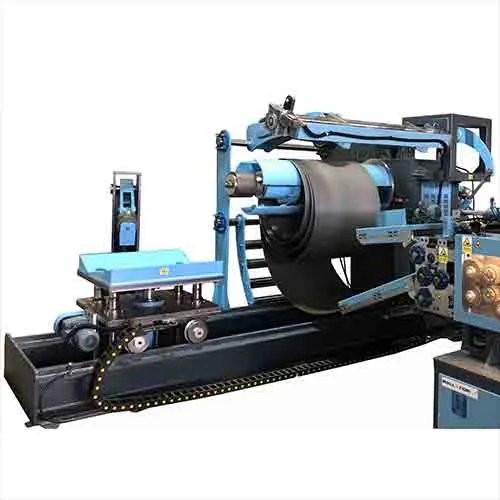
How a slitting line works, what defines its capacity, and the data on coil, strip, tolerances and recoiling you need before choosing a slitting line.
A slitting line cuts a wide master coil lengthwise into narrower strips and recoils them. Roll forming and press shops that buy narrow coils from service centres often consider their own slitting line to cut material cost and lead times.
Main components
- Coil car and decoiler for the master coil
- Entry pinch rolls, straightener and side guides
- Slitter head – circular knives on two arbors, with spacers that set the strip widths
- Scrap winders or choppers for the edge trim
- Loop (pit) and separator / tension stand to recoil all strips tightly
- Recoiler with separator discs, and an exit coil car to unload the slit coils
What defines the capacity
- Thickness range – thin and thick material need different knife sizes and arbor diameters; one line rarely covers everything
- Master coil weight and width
- Minimum strip width and maximum number of strips (cuts)
- Line speed – and the real output including set-up and coil changes
- Width tolerance and burr height required by your downstream process
- Recoil quality – tension method and separator decide how tight and straight the slit coils are
Set-up time matters
On most slitting lines, set-up takes longer than slitting itself. Quick-change features – a second knife arbor set prepared off-line, automatic knife positioning, hydraulic arbor nuts – raise the real output much more than a higher line speed.
Data to prepare
- Material grades, thickness and width range, master coil weight, ID and OD
- Typical slitting patterns: strip widths and number of strips
- Width tolerance and burr requirements
- Slit coil OD and weight limits for your downstream machines
- Annual tonnage and number of pattern changes per shift
Frequently asked questions
What is a slitting pattern?
The combination of strip widths cut from one master coil, for example 4 × 300 mm from a 1250 mm coil with edge trim.
Why do slit coils telescope?
Usually because of uneven recoil tension between strips. A proper tension stand or separator and correct knife set-up prevent it.
Related machines
Request a quote
Send us your profile or part drawing, material and required output, and our sales engineers will propose the right solution.
GET QUOTE sales@rollandform.com